

Pads and tampons work for a lot of people. But maybe they're costing more than you'd like, they don't hold up on your heaviest days, or you're dealing with a few bladder leaks on top of your period. Good news: you've got more choices than ever. This guide compares each one in plain terms so you can pick what fits your body, your budget, and your day.
Quick answer
The main alternatives to pads and tampons are menstrual cups, menstrual discs, period underwear, and reusable cloth pads. Cups and discs hold the most and cost the least over time, but there's a learning curve. Period underwear and cloth pads are easy to use and reusable, but you'll need several and a laundry routine.
Bladder control pads and protective underwear are a different kind of product. They're made for urine, not blood. Some people use them for spotting, discharge, light days, or extra coverage at night, especially if they also have bladder leaks. They aren't a true swap for a period pad on a heavy day.
Compare your options
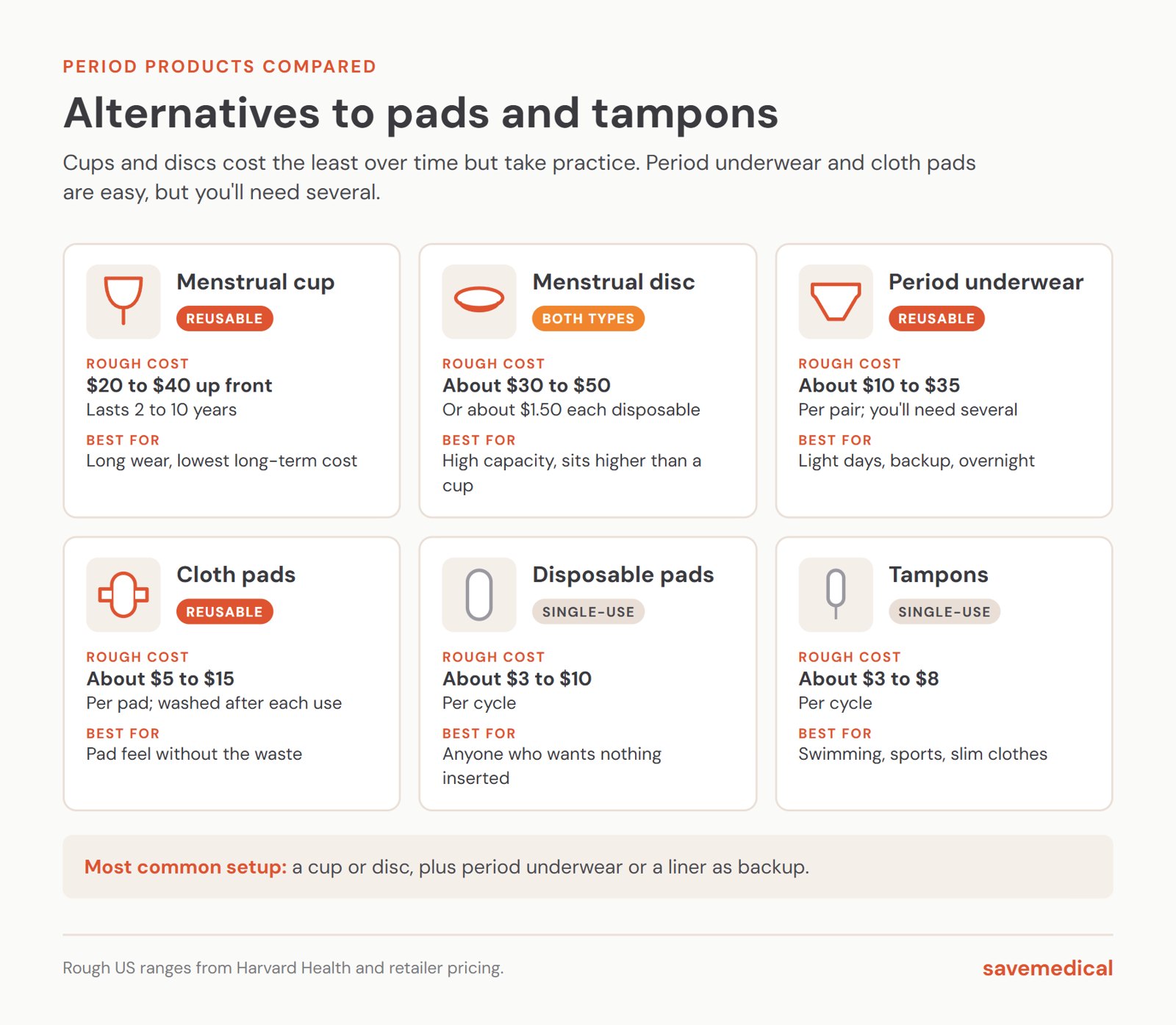
| Option | Reusable? | Rough cost | Best for | Watch-outs |
|---|---|---|---|---|
| Disposable pads | No | About $3 to $10 per cycle | Anyone who wants nothing inserted | Ongoing cost, bulk, can shift |
| Tampons | No | About $3 to $8 per cycle | Swimming, sports, slim clothes | Change every 4 to 8 hours; TSS warning on the box |
| Menstrual cup | Yes | $20 to $40 up front; lasts 2 to 10 years | Long wear, lowest long-term cost | Learning curve, messy emptying, ask your doctor if you have an IUD |
| Menstrual disc | Both | About $30 to $50 reusable, or about $1.50 each disposable | High capacity, sits higher than a cup | Fit takes practice, can spill when removed |
| Period underwear | Yes | About $10 to $35 per pair | Light days, backup, overnight | Need several pairs; can fill up on heavy days |
| Reusable cloth pads | Yes | About $5 to $15 per pad | Pad feel without the waste | Washing and carrying used pads |
| Bladder control pads and liners | No | Varies by pack size | Spotting, discharge, light leaks, bladder leaks during your period | Built for urine; blood and clots can sit on top |
| Protective underwear (pull-ons) | No | Varies by pack size | Full coverage overnight or when you can't change often | Made for urine; test at home first |
Costs are rough US ranges from Harvard Health and retailer pricing. Your real cost depends on your flow and how many products you use.
Menstrual cups
A cup is a soft, bell-shaped cup, usually silicone, that you fold, insert, and empty a few times a day. Many people like how long they can go between changes. Harvard Health says not to leave one in for more than 12 hours, and that a cup can last 2 to 10 years with good care.
Good to know: The first few cycles take practice. Many people wear a liner or period underwear as backup while they learn. If you have an IUD, ask your doctor first, since breaking the seal carefully during removal matters.
Menstrual discs
A disc is a flat, flexible ring that tucks up behind the pubic bone instead of sitting low like a cup. Many hold more than a cup, and some people who didn't get along with cups find discs more comfortable. You can buy reusable discs or single-use packs.
Good to know: Fit is personal. Some people say a disc shifts or leaks a little when they use the bathroom. Removal can be messy until you get the hang of it.
Period underwear
Period underwear looks like regular underwear with an absorbent panel sewn in. You wear it, rinse it, and wash it. It's simple and there's nothing to insert.
Good to know: You'll want a rotation of several pairs, and each pair only holds so much. Many people use it on light days, overnight, or as backup to a cup or disc rather than alone on their heaviest day. Some brands have faced questions about PFAS ("forever chemicals"), so look for brands that share third-party test results.
Reusable cloth pads
Cloth pads snap around your underwear like wings and get washed after each use. They feel familiar if you're used to pads.
Good to know: You'll need a small bag to carry used pads when you're out. Cost per pad is higher up front, but the cost drops the longer you use them.
Disposable pads and tampons, used differently
Not ready to switch completely? Small changes can help. Try an overnight-length pad for sleep, a lower-absorbency tampon on lighter days, or a liner as backup. Always follow the directions on the box. For tampons, FDA guidance is to change every 4 to 8 hours, never wear one longer than 8 hours, and use the lowest absorbency you need.
Can you use incontinence pads for your period?
Sometimes, yes. But it helps to know what you're getting.
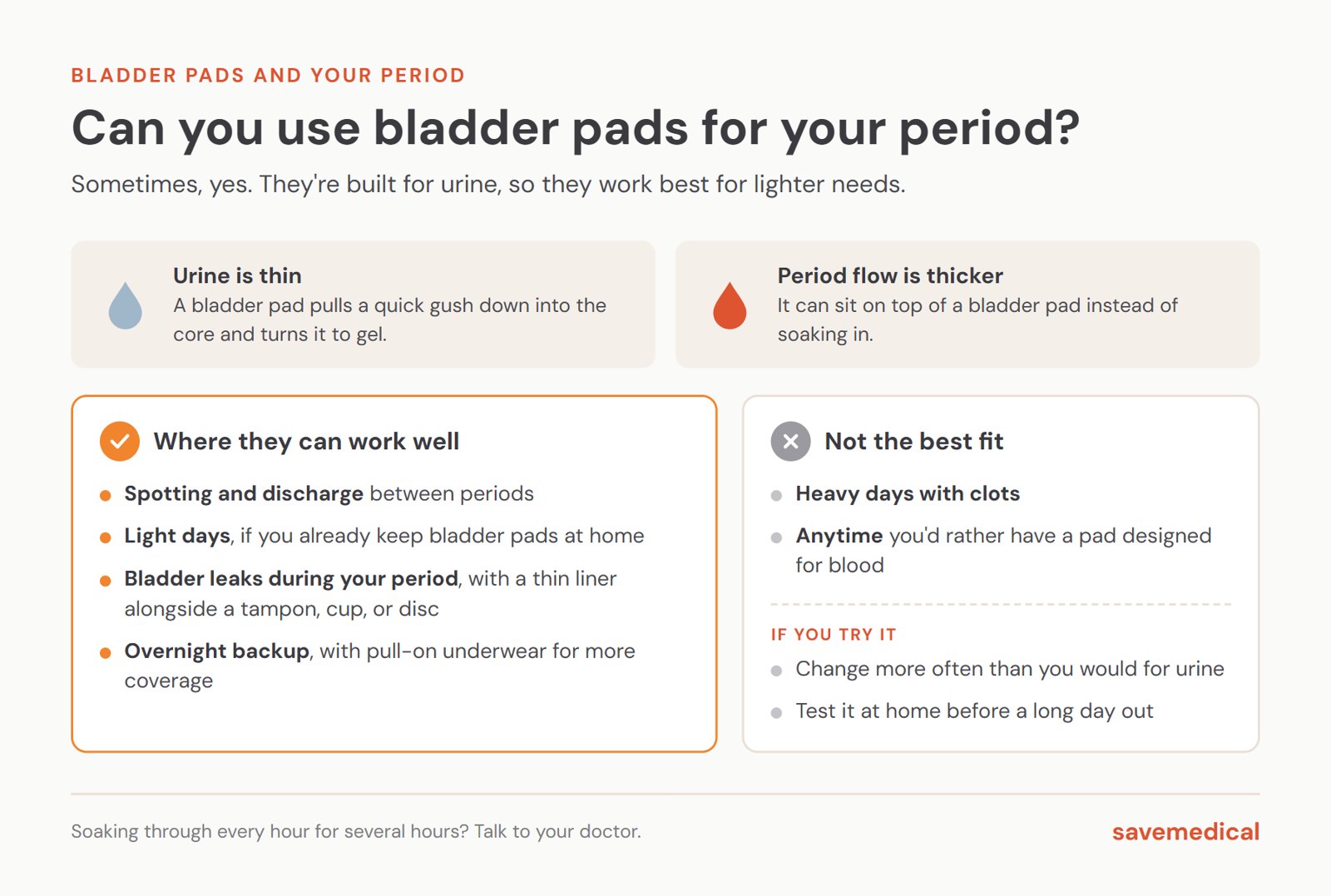
How they're built. Bladder control pads have a core made with superabsorbent polymer, a material that pulls in thin liquid fast and turns it to gel. The top layer is designed to move a quick gush of urine down into that core. Period pads are built for a slower, thicker flow.
What that means for blood. Menstrual blood is thicker than urine and can include clots. It doesn't always travel into a bladder pad's core the same way. It can sit on the surface, spread slowly, or stick when it dries. So a pad that holds a lot of urine won't always feel as clean or dry with blood.
Where they can work well:
- Spotting and discharge between periods. A thin liner or light pad is often plenty.
- Light days. Especially if you already keep bladder pads at home.
- Bladder leaks during your period. Many women in their 40s and up deal with both at once. Some pair a tampon, cup, or disc with a thin bladder liner for leaks.
- Overnight coverage. Pull-on protective underwear covers more of the front, back, and hips than a pad. Some people with heavy nights use them as a backup layer.
Where they're not the best fit: Heavy days with clots, and anytime you'd rather have a pad designed for blood.
Tips if you try it: Change more often than you would for urine. Test it at home before a long day out. If skin feels irritated, switch products.
When to call your doctor: Talk to your doctor if you're soaking through a pad or tampon every hour for several hours, passing large clots, bleeding longer than 7 days, or if heavy periods or bladder leaks are new for you. A product can help you get through the day, but it can't tell you why things changed.
What people say
We read hundreds of comments in period and bladder leak communities, plus our own customer reviews. Here are the themes that came up again and again.
Reader tip
The most common setup we saw was a cup or disc plus period underwear or a liner as backup, especially overnight or during the first heavy days.
- People mix and match. The most common setup we saw was a cup or disc plus period underwear or a liner as backup, especially overnight or during the first heavy days.
- The learning curve is real. New cup and disc users often talk about leaks and messy removal for the first couple of cycles, then getting the hang of it.
- Period underwear has limits. Many like it for light days and sleep, but several say it leaks once it fills up on heavy days.
- Heavy nights call for more coverage. In threads about flooding and perimenopause, some women say pull-on protective underwear was what finally got them through the night. Others said it wasn't cheaper, just more reliable for them.
- Bladder pads and blood don't always mix. A common complaint is that blood stays on top of a urine pad instead of soaking in.
- From our own reviews: Shoppers mention softness and comfort more than anything else. One customer called our Ultimate Pads the best she'd found for nighttime and long trips. Common requests were a longer pad and adhesive that stays put without catching skin or hair.
Our picks
To be upfront: SaveMedical doesn't sell cups, discs, tampons, or period pads right now. We focus on bladder control products. If spotting, discharge, light days, or bladder leaks are part of your month, these are the ones we'd point you to.
- For spotting, discharge, and very light leaks: Prevail Daily Liner Very Light or TENA Sensitive Care Liners. Small and slim.
- For light to moderate leaks on everyday days: Nexwear Moderate Pads. Thin, soft, and quiet under clothes.
- For more front-to-back coverage: Nexwear Maximum Pads, Long. Extra length and a wider shape. One reviewer said it held a lot of discharge through most of a day.
- For heavy leaks, long trips, and overnight: Nexwear Ultimate Pads, our most absorbent pad.
- For full coverage at night: Nexwear Premium Protective Underwear in S/M and L, or Prevail for Women Daily Maximum Absorbent Underwear.
- For day and night: Pair Nexwear Moderate Pads for daytime with Nexwear Ultimate Pads for night.
- To protect your bed: Add a disposable or washable pad from our underpads collection.
Browse all bladder control pads and liners or the full Nexwear line.
Free shipping on orders $75+. Applied automatically at checkout. With Autoship, our automatic delivery program, you can save 5% on eligible items and skip, change, or cancel anytime. Questions? Call us at 866-420-6997.
FAQ
What can I use instead of pads and tampons? Menstrual cups, menstrual discs, period underwear, and reusable cloth pads are the main options. Many people use two together, like a cup with period underwear as backup.
What's the cheapest alternative to pads and tampons? Over time, a reusable cup or disc usually costs the least, since one can last for years. Period underwear and cloth pads also save money, but you need several to get through a full cycle.
Can I use a bladder control pad as a period pad? For spotting, discharge, or a light day, many people do. On heavy days it's not ideal. Bladder pads are made for thin urine, so blood and clots can sit on the surface. Change it often and test it at home first.
Are incontinence pads more absorbent than period pads? For urine, usually yes. Their core is built to hold a lot of thin liquid. That doesn't mean they handle blood better, since blood is thicker and moves differently.
What should I wear for heavy periods at night? Common setups are an overnight pad, a cup or disc with period underwear as backup, or pull-on protective underwear for full coverage. A bed pad underneath adds peace of mind. If you're regularly soaking through protection every hour, talk to your doctor.
I have bladder leaks and my period. What should I use? Some women use a tampon, cup, or disc for their period plus a thin bladder control liner for leaks. Others use a bladder pad and change it more often during their period. Pick what feels comfortable and follow the package directions.

