

If you're doing dressing changes at home, you've probably stood in front of a shelf of pads and wondered which one to buy. Telfa and plain gauze look a lot alike. They don't work the same way, though, and picking the right one can make each change a little easier.
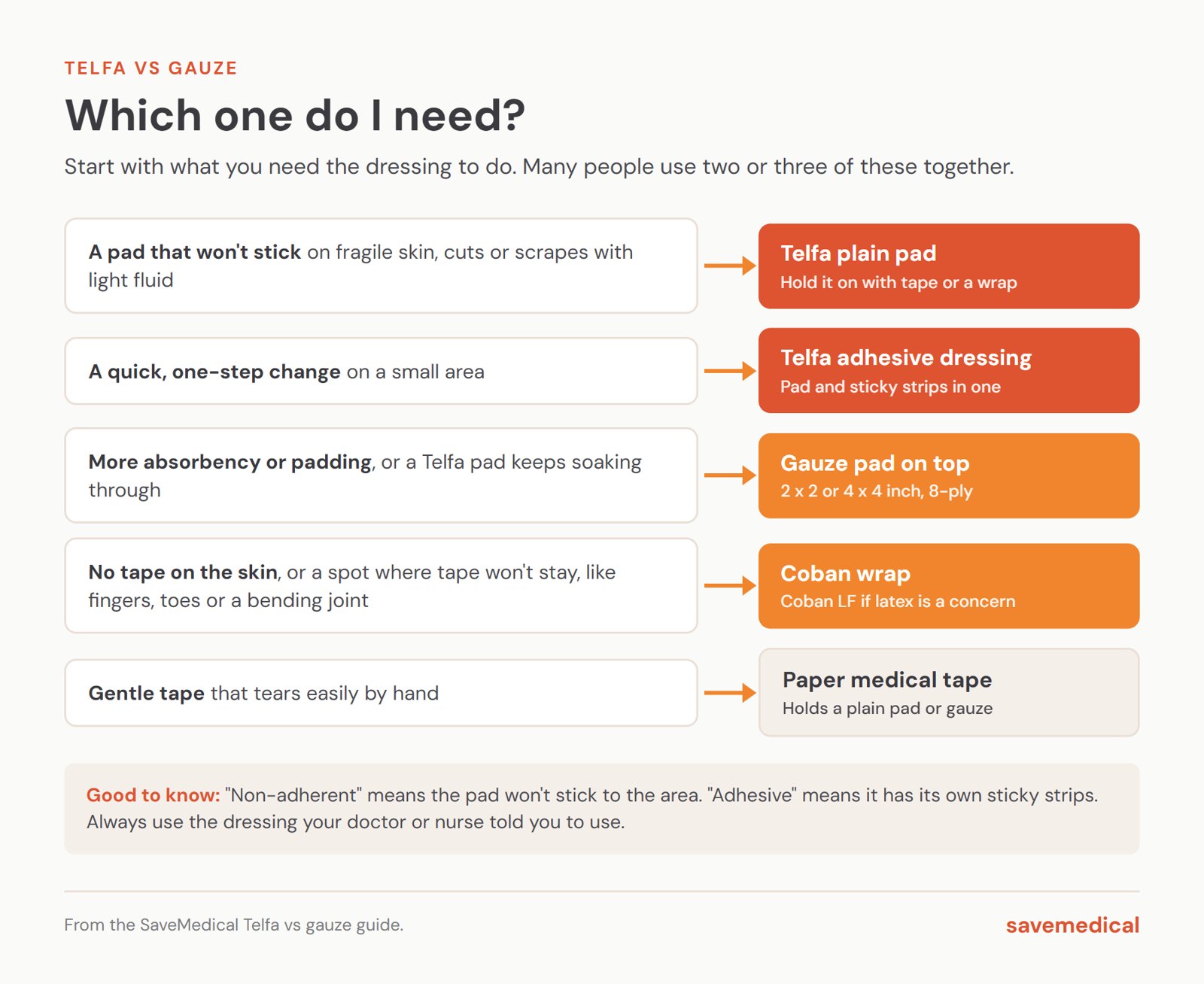
The quick answer
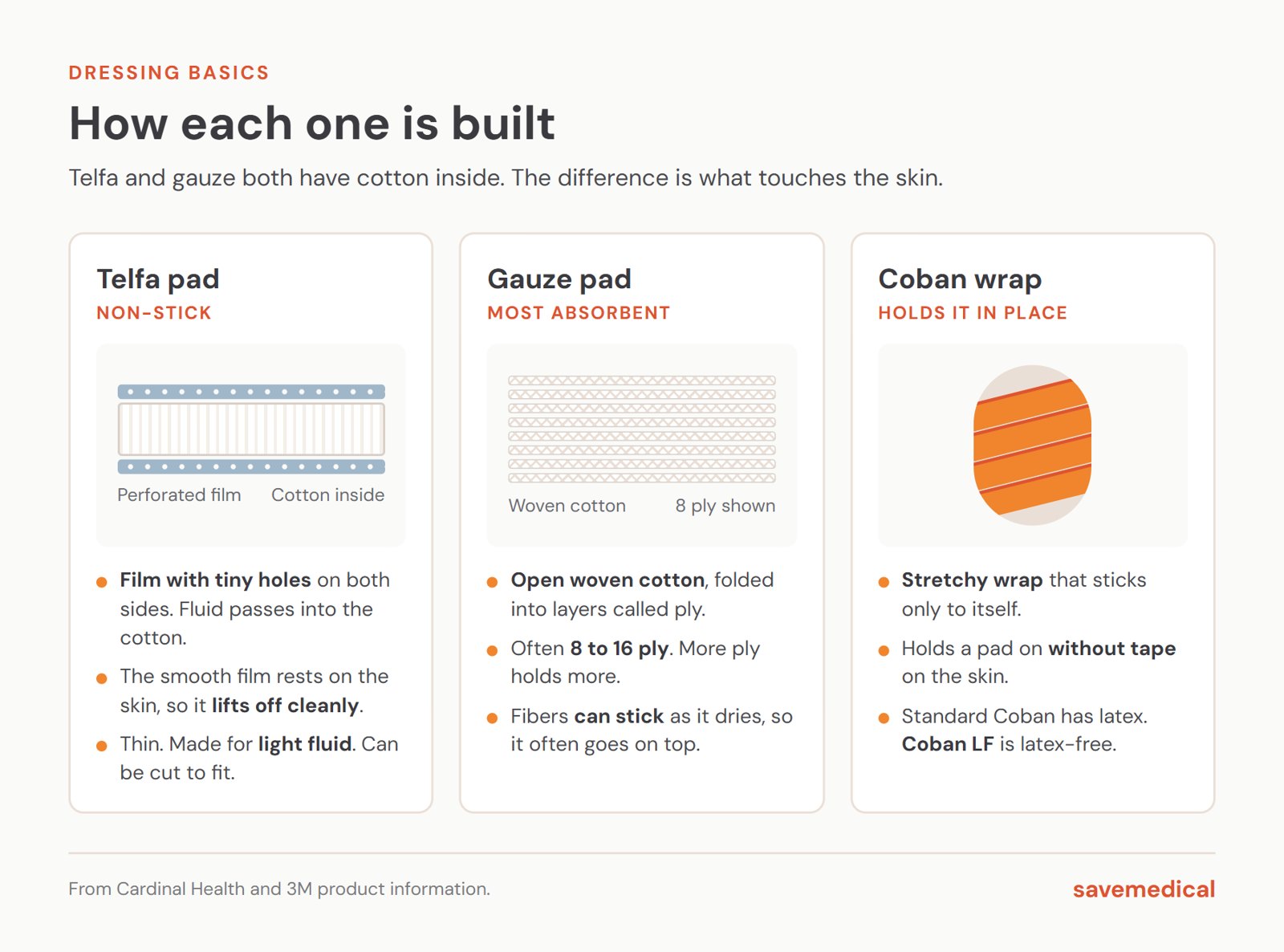
- Telfa is a cotton pad sealed inside a thin plastic film with tiny holes. The film is the part that touches the skin, so the cotton doesn't stick to it. It holds a small amount of fluid.
- Regular gauze is woven cotton with nothing between it and the skin. It soaks up more, but the fibers can grab onto a wound as it dries.
- Telfa adhesive dressings are Telfa pads with built-in sticky strips, so you don't need separate tape.
- Coban is a stretchy wrap that sticks only to itself. People use it to hold a pad in place without putting tape on the skin.
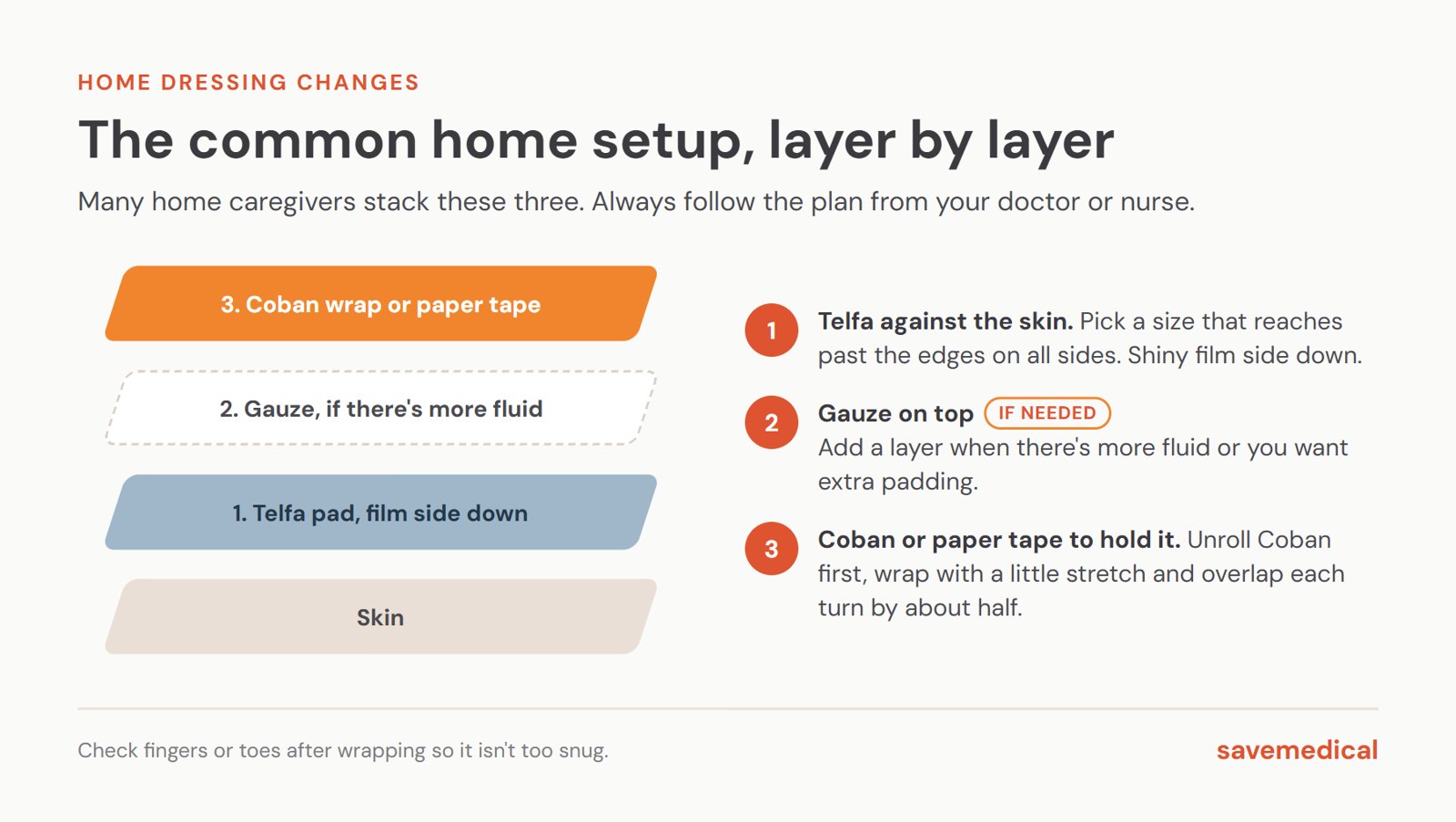
Many home caregivers use them together: Telfa against the skin, gauze on top if there's more fluid, and Coban or paper tape to hold it all in place. Always use the dressing your doctor or nurse told you to use.
Telfa vs gauze vs Coban at a glance
| Telfa plain pad | Telfa adhesive dressing | Standard gauze pad | Coban wrap | |
|---|---|---|---|---|
| What it is | Cotton pad covered on both sides with a perforated film | Telfa pad with adhesive strips | Woven cotton squares, often 8 to 16 layers | Elastic wrap that sticks to itself |
| Sticks to the wound? | Designed not to | Designed not to | Can stick as it dries | Not meant to touch the wound |
| Needs tape? | Yes, or a wrap | No, it has its own strips | Yes, or a wrap | No. It holds itself and the pad |
| Sterile options? | Yes, plus some non-sterile sizes | Yes, each one sealed | Yes, and non-sterile | Mostly non-sterile; some versions come sterile |
| Typical use | Light drainage, fragile skin, cuts and scrapes | Small areas where you want a one-step dressing | Absorbing fluid, cleaning, extra padding | Holding dressings on arms, legs, fingers, toes |
Telfa plain pads: the non-stick layer
Telfa is a brand of non-adherent dressing made by Cardinal Health. Each pad is a thin layer of absorbent cotton bonded on both sides with a perforated film. Fluid passes through the tiny holes into the cotton. The smooth film is what rests on the skin.
A few useful facts from Cardinal Health's Telfa product page:
- You can cut a pad to fit an odd shape, and the layers won't come apart.
- Sterile pads come one per sealed envelope, in sizes like 2 x 3, 3 x 4, 3 x 6 and 3 x 8 inches.
- Some larger, non-sterile pads have film on one side only. Put the film side down.
- Latex labeling varies by item number. Some boxes note latex in the packaging, while others carry a latex-free symbol. Check the box if latex is a concern.
The trade-off is absorbency. Telfa is thin, and it's made for light drainage. If a pad keeps soaking through, ask your nurse whether to add a more absorbent layer on top.
Telfa adhesive dressings: pad and tape in one
A Telfa adhesive dressing is the same non-stick Telfa pad with adhesive strips that hold it in place. Each one is sterile and sealed in its own peel-back package. We carry the 2 x 3 inch and 3 x 4 inch sizes, 100 to a carton.
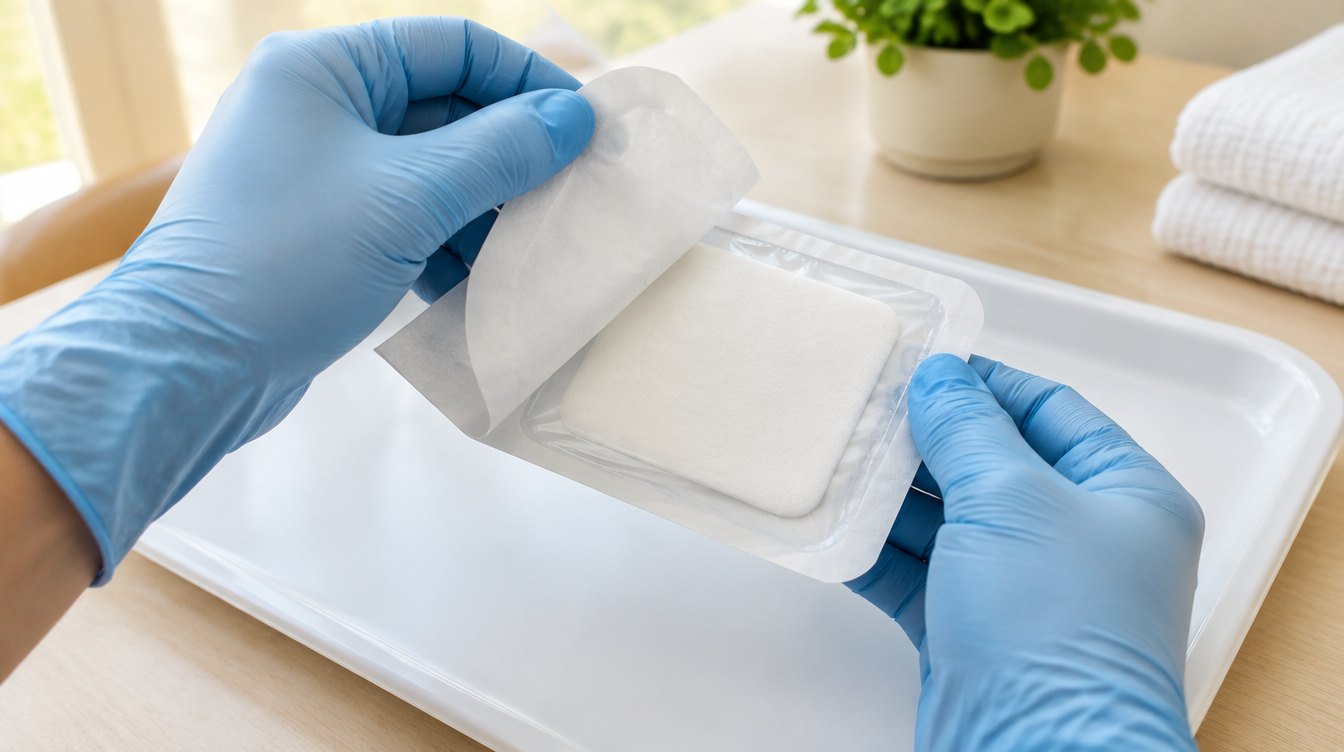
This style is handy when you want a quick, one-step change on a small area. It's less helpful on spots where tape doesn't stay put, like damp or hairy skin, or a joint that bends all day. If the skin around the area is thin or easily irritated, a plain pad held on with a wrap may be more comfortable.
Cardinal also makes a Telfa island dressing (a pad centered on a soft adhesive border) and a version called Telfa AMD. If your care team named one of those, stick with what they asked for.
Regular gauze: the absorbent workhorse
Gauze pads are woven cotton, folded into layers called "ply." More ply means a thicker pad that holds more. Our McKesson sterile gauze sponges are 8-ply and come in 2 x 2 and 4 x 4 inch sizes, two to a sealed pack.
Gauze is great at soaking up fluid and works well as padding. The downside is that open cotton fibers can catch on a wound as it dries, and the pad may tug when you lift it. That's the main reason people reach for Telfa as the layer that touches the skin, with gauze on top.
Coban self-adherent wrap: holds it all without tape on skin
3M Coban is a light, stretchy wrap that sticks to itself but not to skin or hair. You wrap it over your pad, press the last layer down, and it stays. No clips and no tape on the skin. We carry it in 1, 2, 4 and 6 inch widths, all 5 yards long.
Good to know
Don't pre-stretch Coban. Unroll it first, wrap with a little stretch, then check fingers or toes so it isn't too snug.
Two things to know before you buy:
- Latex. Standard Coban is made with natural rubber latex, according to 3M (now Solventum). If anyone in the home has a latex allergy, choose Coban LF, the latex-free version.
- Tension. Coban keeps pulling gently after you wrap it. Unroll it first so it's loose, then lay it on with just a little stretch. Overlap each turn by about half.
What people say
We read through nurse and caregiver threads on Reddit, plus shopper reviews, to see what people like and don't like. Here's what came up most.
- "It actually lets go." Nurses on r/nursing like Telfa for fragile skin and skin tears because it lifts off cleanly. Many layer it with gauze and a wrap (thread).
- It's not very absorbent. This is the top complaint. With more fluid, a Telfa pad can soak through fast. Several nurses said they add gauze or a thicker pad on top (thread).
- Plain vs adhesive mix-ups. Shoppers often order the plain pad expecting it to stick, then realize they need tape. Read the label: "non-adherent" means it won't stick to the wound, and "adhesive" means it has its own sticky strips.
- Coban instead of tape. People with tape-sensitive skin, including folks caring for a tattoo removal site, use Telfa with Coban over it so nothing sticky touches the skin (thread).
- Coban can get tight. Nurses warn that it's easy to wrap too snugly. Their tip: don't pre-stretch it, and check fingers or toes after you wrap (thread).
How to pick the right size
- Cover the whole area with room to spare. Pick a pad that reaches past the edges on all sides. When in doubt, go one size up. You can always trim a plain Telfa pad.
- 2 x 3 inch suits small cuts, scrapes and spots on fingers or hands.
- 3 x 4 inch is the everyday size for most arms, legs and small incisions.
- 3 x 8 inch and larger works for longer areas, like a line of stitches.
- Gauze: 2 x 2 inch for small spots, 4 x 4 inch for padding and extra absorbency.
- Coban width: 1 inch for fingers and toes, 2 inch for wrists and hands, 4 inch for arms and legs, 6 inch for larger areas.
Supplies to keep on hand for home dressing changes
Having everything in one spot makes each change quicker and calmer. Here's a simple checklist:
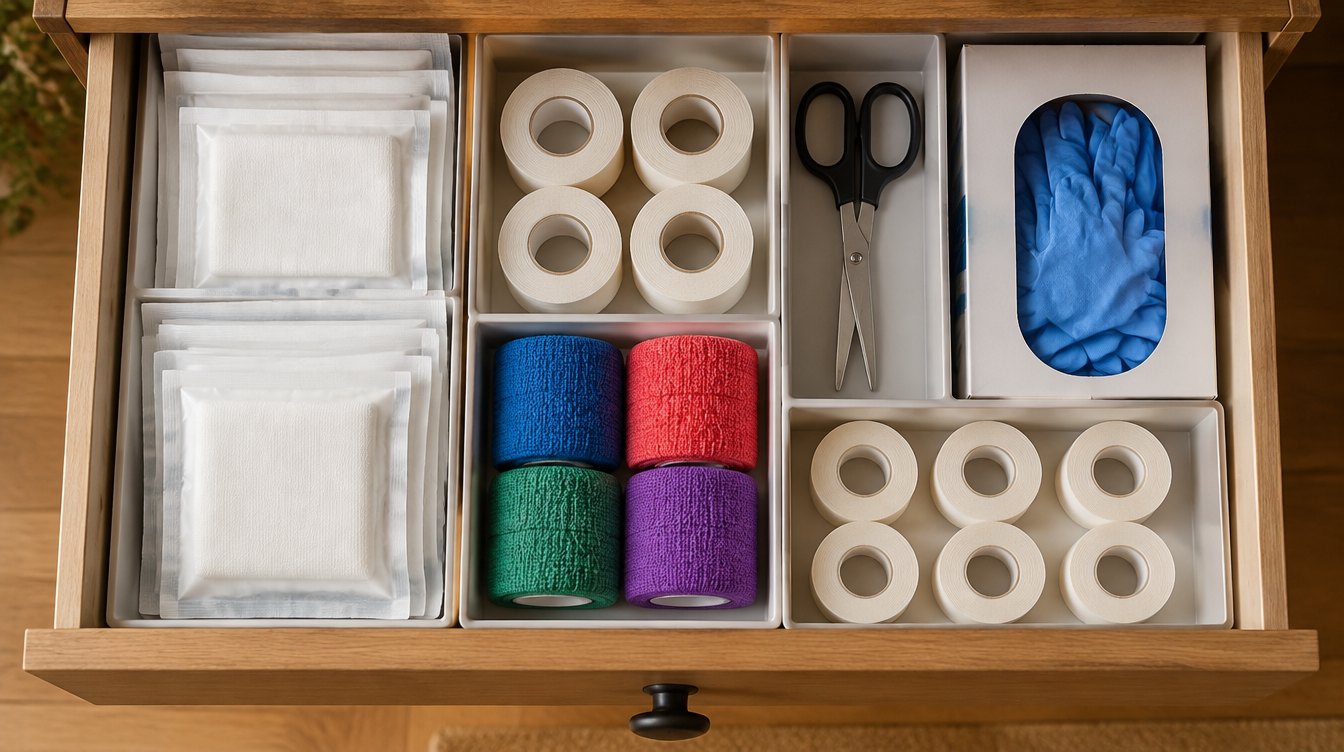
- [ ] Non-stick pads, like Telfa adhesive dressings
- [ ] Sterile gauze pads for an extra absorbent layer
- [ ] Paper medical tape, which is gentle and easy to tear by hand
- [ ] Coban wrap or latex-free Coban LF
- [ ] Disposable gloves
- [ ] Clean scissors used only for dressings
- [ ] A small trash bag for used supplies
- [ ] Your written care instructions from your doctor or nurse
You'll find more options in our medical tapes and gauze collection. Free shipping on orders $75+. Applied automatically at checkout.
Follow the wound care instructions from your doctor or nurse. Call them if a wound looks red, swollen, or isn't getting better.
Frequently asked questions
What is Telfa used for? Telfa is a non-stick dressing pad. People use it to cover cuts, scrapes, small incisions and other areas with light drainage, where they don't want the pad to stick when it comes off.
Is Telfa the same as gauze? No. Both have cotton inside, but Telfa's cotton is sealed in a perforated film, so the cotton doesn't touch the skin. Gauze is open cotton. Gauze holds more fluid, while Telfa lifts off more easily.
Which side of a Telfa pad goes down? Most sterile Telfa pads have film on both sides, so either side works. Some larger non-sterile pads have film on one side only. Put the shiny film side against the skin.
Do Telfa pads need tape? Plain Telfa pads do. Use paper tape or a wrap like Coban. Telfa adhesive dressings have their own sticky strips, so they don't need tape.
Can I cut Telfa pads? Yes. Cardinal Health says plain Telfa pads can be cut to any shape without the layers separating. Use clean scissors. Adhesive dressings are best used whole.
Is Coban latex-free? Standard 3M Coban contains natural rubber latex. If you need to avoid latex, look for "LF" on the label, like our Coban LF.
Questions about which product fits your needs? Call us at 866-420-6997. We're happy to help.

